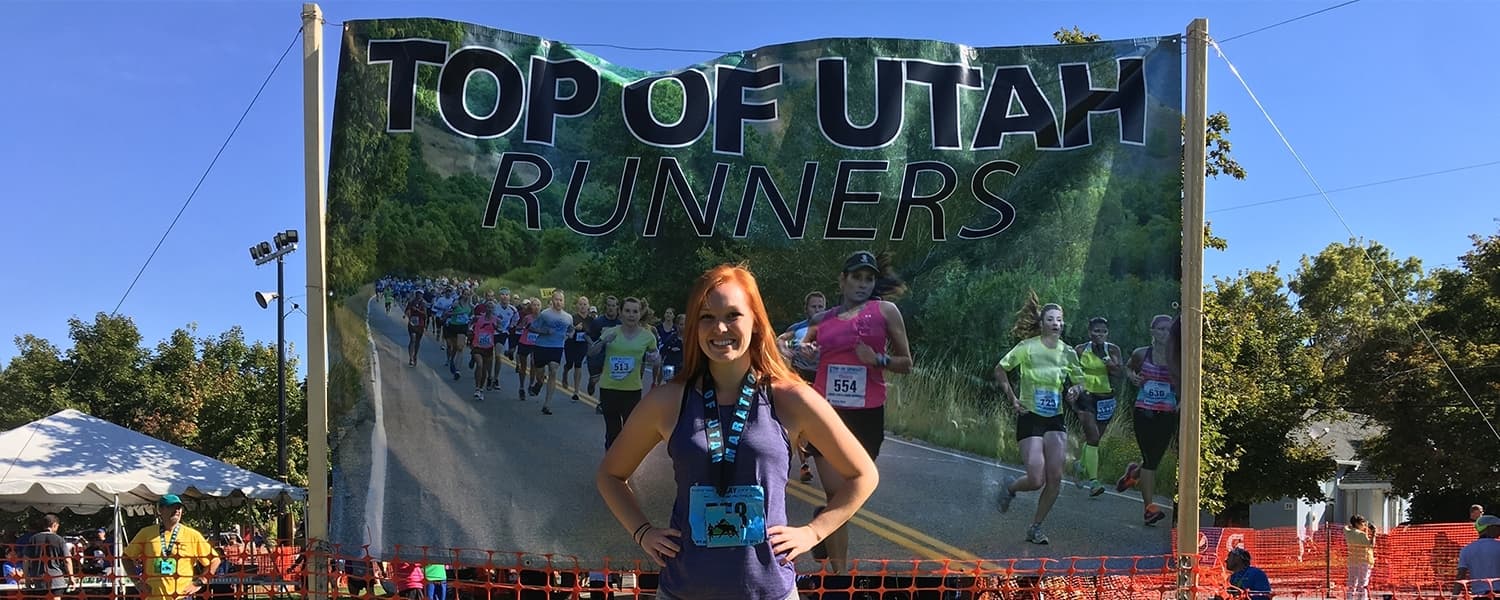
My Half Marathon Experience
This story was written by iFit employee Becca Capell.
A little bit about me before I start—I like to run. I’ve ran competitively since I was 11 years old, and as of late, I’ve become a bit of a race junky. This year alone, in a space of three months, I ran a duathlon, trail half marathon, road marathon, and three 50K trail ultramarathons. That might sound impressive to some, but what it did was leave me very burnt out. I was tired of my weekends revolving around 20-mile runs, and having to travel for a race every other Saturday. I was ready for some “me” time. I decided to take the next month off from organized training. I still ran on occasion and lifted, but I didn’t commit to an official schedule.
I’ll be honest. I loved that time off. If I wanted to go running, I went running. If I didn’t feel like it, then I didn’t. I felt free. I wasn’t strapped down to a training calendar that ran my life (pun intended). I was able to do what I wanted, when I wanted, and I didn’t have to feel guilty about not sticking to something I had committed to.
Then I looked at my calendar.
“How is it August already?”
It snuck up on me like college deadlines used to. And there I was, less than three weeks out from my race, completely unprepared. And I don’t mean unprepared as in I wouldn’t be able to finish, but rather unprepared in the sense that my time would probably hurt my pride just a tad. I usually love half marathons because they’re “short,” generally not super challenging courses, and I’m usually well prepared for them. I knew that this race was not the case.
In those three weeks prior to race day, I started a more structured running schedule, running three to four days per week. I also came to terms that this race would be more of a training run for my marathon that was five weeks later. Accepting the fact that I didn’t need to race the clock took some stress off and alleviated a lot of the pressure I’d put on myself. I dropped my expectations and just acknowledged that I probably wasn’t going to run a sub 1:40 half. And that was okay (or so I kept telling myself).
The week before the race, I adhered perfectly to my running calendar and felt pretty good. The night before races, I tend to have a very structured diet intake, but sometimes life gets the best of us. After teaching my nightly fitness class, I headed straight to a work party (okay fine...it was fantasy football draft night), and the dinner that was provided: wings. Now, wings aren’t exactly the pre-race cuisine I’m accustomed to, but I was hungry, so wings were what I ate. Plus, who says no to free food? I consumed some good carbohydrates before bed as a last ditch effort to aid in my nutrition, and tried to ignore the pre-race nerves as I settled into bed early on Friday night.
“Bzzzzz, bzzzzz, bzzzzz.”
“Ugh.”
4:00 a.m. always comes too early. Always.
I scrambled to put on my race day outfit I’d laid out the night before, complete with my pre-pinned-on bib number, and sweats to keep me from freezing at the start of the race. I headed downstairs to whip up some oatmeal, then grabbed my drop bag for my extra clothing and headed to catch the buses.
The bus ride is always a bit unnerving since it seems to take an eternity to get from the finish line to the start, and all I could think was, “I have to run all the way back to my car.” Eventually I made it to the start, listened to the volunteer explain where the aid stations would be, and how to find our drop bags at the finish line. Then, the waiting began. To this day, I still don’t understand why they bus people to the starting line just so they can wait for 90 minutes trying to not become human icicles. I call it cruel and unusual punishment, they call it race logistics.
About 10 minutes prior to the start, I scarfed down my habitual rice crispy treat (I think they’re good luck before a race, not to mention delicious), stripped down to my singlet and shorts, and lined up according to my anticipated finish time. The gun went off and I started my watch as I crossed the starting line. I had 13.1 miles to go.
The first half of the race was a gradual descent down a canyon road. The views were incredible and I felt like I was flying once I found my rhythm. For me, the first mile or so tends to be the hardest part of the race as I try to find my groove, but once I’m there, it’s smooth sailing. The first seven miles passed by without a hitch, and as the course leveled out, I knew I just had to maintain my pace. I kept thinking, “Open up on the downhills and push through the uphills.” I couldn’t settle into a comfortable pace, I just had to keep pushing myself. There were a few short climbs around mile 10, and then again from mile 11–12, but I knew I just had to keep moving. If I wanted to finish under my “modified” goal time of 1:50, I had to run my last two miles on pace. I persisted and ended up completing the race 25 seconds ahead of my adapted goal time.
All things considered, it was a great race. Not my fastest, but a PR for that course, and I felt great the whole time. No aches, pains, or nausea, so I call it a success. I guess eating wings might just be the secret to a great race.
Keep running,
Becca Capell
Runner
WARNING: This post is not intended to replace the advice of a medical professional. The above information should not be used to diagnose, treat, or prevent any disease or medical condition. Please consult your doctor before making any changes to your diet, sleep methods, daily activity, or fitness routine. iFit assumes no responsibility for any personal injury or damage sustained by any recommendations, opinions, or advice given in this article.
You might also like

Enter for Your Chance to Run with Team iFIT at the 2026 Boston Marathon® Presented by Bank of America
For countless runners and athletes, the Boston Marathon® presented by Bank of America is the ultimate dream, from the iconic starting line in Hopkinton to the challenge of Heartbreak Hill and the rush of crossing the finish line on Boylston Street.How it worksWe will be giving 10 qualified runners the opportunity to cross the 2026 Boston Marathon® finish line with Team iFIT. Not only will runners get a chance to run and join Team iFIT, but they will also receive an iFIT training guide and mentorship from an iFIT Trainer.What we are looking for:Vertical videos no longer than 3 minutes long that tell a compelling story about why you want to join Team iFIT for the 2026 Boston Marathon®.You can include friends and family to help tell your story. We encourage you to include photos and additional video clips you feel would help add to your story. Tag @iFIT and use #TeamiFIT and #iFITMarathonOpportunity in your video. Questions and prompts to consider when creating your video:Tell us why you would make a great member of Team iFIT. Tell us your inspirational story, why we should select you, and what makes you stand out from the crowd. What would crossing the Boston Marathon® finish line mean to you? Imagine your support team is meeting you at the finish line, what would you tell them?Describe your past experience(s) with distance running — including marathons, 5K/10K, running clubs, or other activities to demonstrate your readiness.How has iFIT, ProForm, or NordicTrack played a role in your fitness regimen?The Details and Rules:Entrants will have until January 4, 2026 at 11:59 pm PT to share a video via social media (Instagram and Facebook) highlighting why they want to run the Boston Marathon® in 2026. Videos up to 3 minutes maximum are acceptable. Video submissions must tag @iFIT and use #TeamiFIT and #iFITMarathonContest. Applications and videos can then be submitted through this form.All videos will be initially screened by iFIT staff to ensure video contest guidelines are followed for acceptance into this video contest. Accepted videos will be reviewed by a panel of iFIT staff. Collectively, this panel will select the winners. Winners will be contacted via email.This opportunity runs from December 24, 2025, at 12:00:01 am PDT until January 4, 2026 at 11:59 pm PDT. The iFIT Team will review all submissions and announce recipients on or around January 20, 2026. Click here for the Official Rules.OPORTUNIDAD DE MARATÓN REGLAS OFICIALESOPPORTUNITÉ MARATHON RÈGLEMENT OFFICIELOnly U.S. (including U.S. territories), UK, Canada, Mexico, U.K., and Australia residents aged 18 and older are eligible to participate.
December 23, 2025

My Altra Running Shoe Review
Are you a runner? Are you looking for the perfect running shoe? Throughout my many years of running, I’ve tried just about every brand of running shoe out there. I’ve loved using lots of different brands, but none more than Altra. During my schooling, Biomechanics was one of my favorite subjects. I was so intrigued by the huge cascading effects that heel elevation could have on the body. So initially, the Zero Drop™ feature of Altra running shoes was what sold me on my first pair, but their excellence is what has kept me wearing them race after race, year after year. My Favorites: The Top 3 FOR THE TRAIL The Superior 2.0 This is the perfect lightweight trail running shoe. It weighs in at only 7.5 ounces, has incredible tread to keep you from sliding around on even the slipperiest of slopes, and comes with a removable StoneGuard™ to keep your feet from feeling any sharp and pointy rocks. When it comes to rough terrain, this is my go-to shoe. Whether I’m running, or just going for a technical hike, the Superior 2.0 is a great option for a breathable trail shoe. Plus, when I put this shoe on for the first time, I couldn’t believe how great it felt. It’s like it was made for my foot! FOR THE ROAD The One 2.5 If you want to feel fast, then this is the shoe for you. The One offers incredible flexibility and is the lightest shoe in the Altra line-up weighing in at 5.2 ounces. This shoe surprised me from the instant I picked it up. It hardly feels heavy enough to be a shoe, but it’s an exceptional one. The One allows for your foot to flex in the shoe, which can help strengthen and support your arches, and allows for a more natural running form. This is my favorite shoe for shorter road runs and any speed work. It can also double as a racing flat since it’s so lightweight. FOR THE LONG HAUL The Torin 2.0 When it comes to marathon running, this is the shoe that has the support to keep your feet healthy and happy. The Torin is a high-cushion shoe, and still relatively lightweight at 7.5 ounces. Altra did a great job with keeping good flexibility in this shoe, especially considering the higher stack height and robust appearance. For those long training runs, or even on race day, this shoe is great for an endurance road runner. Why Altra? Altra is an up-and-coming shoe company with quality shoes that are backed with some serious education. There’s nothing left up to chance with these shoes. They are running shoes made by very educated and very experienced runners. That’s why they’re on the forefront of footwear innovation. Zero Drop™ Advantage Every Altra running shoe features the Zero Drop™ platform. This means that the heel and forefoot of the shoe have an equivalent stack height and there is no elevated heel, unlike just about every other brand out there. This encourages a forefoot or midfoot strike, rather than the heel striking with every step. In the long term, this not only helps with your entire body alignment, but it can immensely reduce the force that travels through your body. FootShape™ Toe Box The FootShape™ Toe Box on Altra shoes gives your toes the room they deserve! Your toes can splay and keep your natural form on point. After running in my Altra shoes, every other pair of running shoes seems to cram my toes into a narrow and pointy toe box (I even have fairly narrow feet!). In my mind, once you go Altra, you’ll never go back. To learn more about Altra’s technology and innovative designs, visit altrarunning.com. Becca Capell iFit Head Trainer WARNING: This post is not intended to replace the advice of a medical professional. The above information should not be used to diagnose, treat, or prevent any disease or medical condition. Please consult your doctor before making any changes to your diet, sleep methods, daily activity, or fitness routine. iFit assumes no responsibility for any personal injury or damage sustained by any recommendations, opinions, or advice given in this article
July 26, 2015

Shin Splints Treatment
Shin splints, or medial tibial stress syndrome, is one of the most common injury for runners. Symptoms include pain, tenderness, swelling, redness, and warmth during weight-bearing activities. There are many theories about what exactly causes the pain of MTSS, although nothing’s conclusive. The most common theory is that the pain in the front, lower leg results from inflammation around the muscles, tendons, and ligaments pulling on the periosteum (the membrane around the bone) of the shin bone. Common causes of shin splints include: inadequate stretching, over-pronation, worn shoes, an imbalance between your calf muscle and muscles in the front of your leg, chronically tightened calf muscles, incorrect form, heel strikes that come from overly-long strides, hill running, hard running surfaces, or too much training. Prevention Warm up. Increase exercise intensity gradually. A rule of thumb is a 10 percent increase each week. Click here for a more in-depth explanation. Stretch after your workout. Stretch the anterior muscles of your lower leg by crossing your ankle over your opposite knee and pulling the top of your foot towards your body. Be sure to stretch your calves, as well, since they can become too tight and put a strain on your tibia. Foam rolling. This is one of my favorite ways to utilize a foam roller. Whenever I feel shin splints coming on, I do this before and after every run or workout. Vary your training surface. Consume 1,000 mg of calcium each day. Check your shoes. If they’re too worn, then they’ve lost their structure, and it’s time to get new ones. The American Academy of Podiatric Sports Medicine considers shoes to be worn out after 300-500 miles of walking or running. Engage in strength training. This is where muscle imbalances will come into play. Both your calves and your frontal muscles need to be strengthened and stretched. The movement below will engage those frontal muscles that are hard to work. You may also spell the ABC’s with your toes from this position without a weight. Perform calf raises in all three directions: pigeon toed, duck footed, and straight; this will encourage strengthening of all aspects of the calf muscle.: Here’s a quick warm-up before going on a run. All these should be done barefoot and on grass or a soft surface Walk on heels, toes turned out. Walk on heels, toes turned in. Walk on toes, heels turned out. Walk on toes, heels turned in. Walk across the grass, pulling out the grass using just your toes (if you’re indoors, lay a towel out flat on the floor in front of you and scrunch it up with your toes, instead). Treatment Keep your legs elevated. Ice for 15-20 minutes several times a day. Use an icepack or combine with a massage by making a small ice cup (like the one below) and rubbing it over the inflamed area. Rest. Avoid any activity that causes pain. Cross-training may be continued to keep up endurance levels (biking, elliptical machine, swimming, weight training.) Estimates of healing time for shin splints range from two weeks to six months. The longer you push yourself without listening to your body, the more time you’ll have to take off from your activity to recover. After the pain is alleviated, give yourself another one to two weeks before running again, and continue icing and elevating. When you come back, don’t expect to jump back in right where you were before the injury. Allow yourself a slow start, and slowly work back up your mileage and intensity. Take over-the-counter pain medications (NSAIDS). Wear compression socks or neoprene sleeves. This helps warm up the lower leg and restricts your muscle movement. Get orthotics, shoe inserts that provide support and distribute impact forces. Check your form. I’ve always been a heel striker, which leads to chronic shin splints. By switching my shoes to a zero drop brand I was able to correct my form and say “goodbye” to my shin splints! Emily Wiley iFit Trainer WARNING: This post is not intended to replace the advice of a medical professional. The above information should not be used to diagnose, treat, or prevent any disease or medical condition. Please consult your doctor before making any changes to your diet, sleep methods, daily activity, or fitness routine. iFit assumes no responsibility for any personal injury or damage sustained by any recommendations, opinions, or advice given in this article.
December 31, 2015