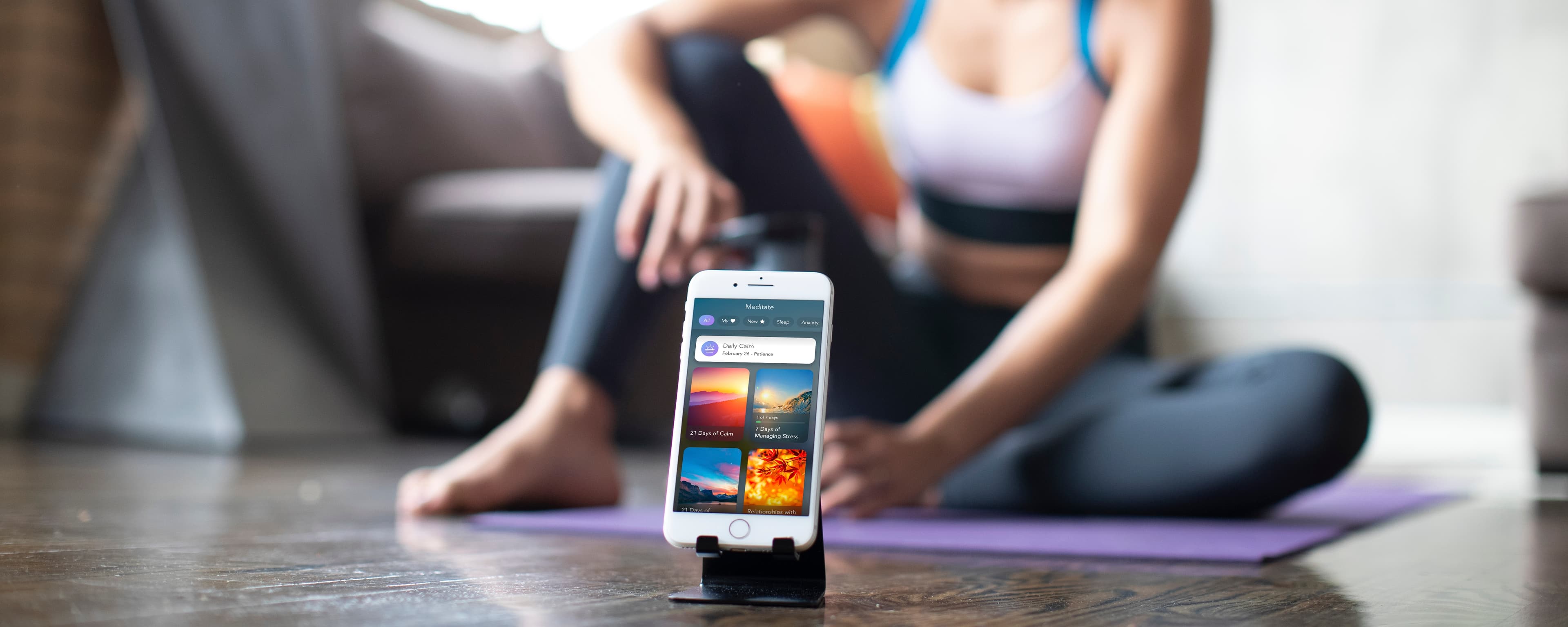
Did you know that April is Stress Awareness Month? At iFit, we love taking any opportunity we can to raise awareness and improve your overall health.
When my work and life become busy and chaotic, emails, text messages, and calls seem to be blowing up on my phone nonstop. Sometimes, I even switch my phone on "Do Not Disturb" mode and toss it as far away from me as possible, just so I can take a moment to breathe. What I hadn’t realized is that my phone can also act as a tool to help me destress.
It’s true! There are hundreds of apps available on your phone that can act as resources to relieve stress and help you unwind. After doing some research, here are my top four stress relief apps, tested, rated, and reviewed by yours truly.
1. Calm

Visually, Calm is everything you expect from a stress relief app. Its use of cool colors, natural scenery as backgrounds, and sounds of nature that play while the app is open are automatically relaxing. Every day, you are offered a Daily Calm activity, which is an audio-guided meditation, aimed to focus on a certain issue...for example, work stress. If you’re like me and have a hard time closing your eyes and just focusing on audio, Calm offers a relaxing scenery of a lake and background audio to go with it (you can also choose different scenery from the settings). You can link your Daily Calm activity to Siri and have her play it for you without going through the app. You can also set a mindfulness reminder, share your statistics, and view your streaks (how many days you’ve meditated in a row). You can access the soothing music library, different meditation programs, and even listen to masterclasses on topics such as Mindful Parenting.
2. Headspace: Meditation & Sleep
Visually, what sets Headspace apart is its use of bright colors and animated characters. When prompted for my reason behind using Headspace, I selected Stress & Anxiety. It also asked me my level of experience with meditation, making the app feel slightly personalized (although they all do). The free trial of headspace includes 10 meditation sessions over a span of 10 days. From there, you have to subscribe to unlock premium usage. You can customize the length of your meditation sessions, choose from their extensive library, track your progress, and save it to Apple Health Kit. To help you sleep, there are different audio experiences that you can choose from, including sleepcasts and sleep music.
Aside from meditation programs, the app includes Eyes-open Exercises, Headspace for Kids, Single Meditations (for when you don’t have much time), and six SOS sessions to give you relief during meltdown moments.
3. Breethe
Every day, Breethe gives you a recommended Daily Breether, a 10-minute meditation that targets a different theme each day, based on your personal goals. The Meditation library is organized, based on different genres or needs, such as Anytime, Anywhere, Life Situations, Themed Weeks, Kids & Family, and even Less Guidance. The Less Guidance meditations are a convenient feature, because they offer minimal verbal guidance, blended with music, nature, sounds, or silence. These are perfect if you’re looking to let your mind rest without a voice telling you when to breathe or what to let go of. Breethe also includes hypnotherapy sessions, inspirational talks, masterclasses, and calming videos to help you relax.
In the sleep section, you can find Bedtime Stories, Visualizations, and Sleep Music & Nature Sounds to help you fall asleep.
4. Aura

Aura first asks you how mindful, positive, or stressed you tend to be, then asks you to choose a time for a daily, 3-minute moment to yourself, You tie that moment to an existing habit; for example, after showering or first thing at work. You can also set a different time for weekends. In order to unlock all of the content inside Aura, you must complete your first, 3-minute meditation.
The nice thing about Aura is that it will ask you how you’re feeling each day before giving you a recommended meditation. Aura also uses a subscription method, where you can subscribe to certain channels, speakers, stories, and music. There is also an online community within the app where people can share their experiences with specific meditations, then recommend them to others.
All of these are great resources, and there are many more out there! Be sure to do some research and find what works best for you!
You might also like

iFIT Trainer Casey Gilbert Shares His Journey to Well-Being
May marks Mental Health Awareness Month, a time to fight the stigma, raise awareness, and support the millions of people around the world living with mental health conditions. We spoke with iFIT Trainer Casey Gilbert, who shared what mental health means to him, challenges he’s faced, and how it inspires his fitness journey. To learn more about Casey, follow him and iFIT on Instagram. And be sure to take care of yourself with our TBD Mental Health Collection, featuring refreshing workouts that support your physical strength and emotional well-being. Casey, how has prioritizing your physical fitness and mental health affected your overall well-being? Casey: “I started prioritizing my physical fitness because it was something that made me feel good, made me feel calm, and made me feel productive. But I didn’t realize until a few years ago that I was also prioritizing my mental health. There’s been plenty of times when, if I’m stressed or anxious, I don’t find myself able to perform physically. Taking moments to breathe, be mindful, and check in with yourself can benefit your physical health. Taking a step back sometimes can help me move forward in my fitness journey.” What inspired you to start prioritizing your mental health? Casey: “Since diving into that passion and purpose of prioritizing my mental health, I found that my overall well-being has drastically improved. I’m able to show up more for myself and those around me, and it’s been quite the journey that I am looking forward to continuing.” Have you experienced times when your mental health affected your physical fitness? Casey: “Those who know me know that I’ve struggled for a long time with anxiety, depression, overthinking, and [feeling] overwhelmed. I think that’s part of the human condition, and it makes me feel more human. When I share that on social media and with the iFIT Community, I’ve gotten an overwhelming response of positivity.” How do you manage those feelings when they arise? Casey: “As soon as I realize I’m not the only one going through it, I try to think about how [I’m] feeling in that moment and being okay with that. It’s a fitness journey, right? We’re trying to build our bodies and get healthier. But it’s also a journey of the mind to figure out who you are and build on that.” One last question. Do you have advice for people who want to create a healthy balance between fitness and well-being? Casey: “Just like building your body, think of your mental health as a journey. You’re not going to flip a switch and have everything figured out, just like you’re not going to do one bicep curl and have Arnold [Schwarzenegger] arms. It’s a process, and practice makes progress. Also, be kind to yourself. It’s going to take time. You will have setbacks, but that’s the part of the journey. We’re here together. We’re experiencing life together, so have grace with yourself. You’ll get exactly where you need to be as long as you keep showing up and doing your best.” Conquer your goals with Casey! Like Casey says, “Consistency and dedication are the only ways to approach a task—and conquer it.” Join these iFIT Series with Casey and give your mental health the attention it deserves. Bhutan: The Journey Within Join Casey and iFIT Guide Kenton Cool on 10 intermediate hikes and jogs in Bhutan, finding happiness and gratitude every step of the way. Join the Bhutan: The Journey Within Series 2021 Virgin Money London Marathon® Series Race through the 2021 Virgin Money London Marathon® with iFIT Trainer Casey in five advanced workouts as Casey leads you along this legendary and historic course. Join the 2021 Virgin Money London Marathon® Series New England Interval Series Join Casey for 12 beginner jogs, increasing your endurance and speed while taking in stunning sites across New England. Join the New England Interval Series Disclaimer: This blog post is not intended to replace the advice of a medical professional. The above information should not be used to diagnose, treat, or prevent any disease or medical condition. Please consult your doctor before making any changes to your diet, sleep methods, daily activity, or fitness routine. iFIT assumes no responsibility for any personal injury or damage sustained by any recommendations, opinions, or advice given in this article. Always follow the safety precautions included in the owner’s manual of your fitness equipment.
May 15, 2023
Be Active. Be Healthy. Be Happy: The Fitness Month Challenge
May is National Fitness Month, and we’re here to celebrate with you! Join us, and make time for your health with the inaugural Fitness Month Challenge! Whether you want to restart your routine or push yourself to conquer new goals, join your favorite iFIT Trainers for 6 weeks of “mini-Challenges,” starting with National Fitness Month and ending on Global Running Day on June 7. Complete the workouts from your selected level for each week of the Fitness Month Challenge and earn a digital reward in your Trophy Case to share with your family and friends! At the end of the Fitness Month Challenge, check your email for an exclusive one-time offer to purchase a commemorative Fitness Month Challenge t-shirt, so you can show off your success! See the Fitness Month Challenge FAQs section for more details. Read on to learn more about our weekly mini-Challenges! Week 1: EnergyWeek 2: CommunityWeek 3: MindWeek 4: ElevateWeek 5: NatureWeek 6: MovementFitness Month Challenge FAQs Week 1: Energy To kick off the Fitness Month Challenge, energize your body with workouts under 20 minutes to get outside and take in the fresh air in a flash! Complete the workouts from your selected level for Week 1 between May 1 - May 7 and earn a digital reward in your Trophy Case. Stay tuned for Week 2, and discover how having #squadgoals can transform your fitness journey. Here are this week’s mini-Challenges: Treadmill and elliptical workouts Walking: Give your body a boost with two energizing walking workouts, each under 20 minutes. Join iFIT Trainers Elyse Miller, John Peel, and Michael Phelps in Nashville and Maui! Join Week 1: Energy (Walking) Running: Looking for an energizing run but short on time? Join iFIT Trainers Alex Morgan and Jonnie Gale in Florida and Iceland for 2 running workouts, each under 20 minutes! Join Week 1: Energy (Running) Bike workouts Casual Riding: Join iFIT Trainers Gideon Akande and Nicole Meline and feel energized in Bermuda and Montana! These 2 bike workouts are under 20 minutes, so make every moment count. Join Week 1: Energy (Casual Riding) Amped Cycling: In a time crunch but want an energizing ride? Join iFIT Trainers Casey Zaugg and Richard Biglia for 2 cycling workouts, each under 20 minutes! Join Week 1: Energy (Amped Cycling) Rower workouts Rowing: Have 20 minutes to spare? Hop on your rower and get energized with iFIT Trainers Alex Silver-Fagan and James Stephenson! Learn to row longer and stronger while getting a fantastic workout in. Join Week 1: Energy (Rowing) Strength workouts Strength: Join iFIT Trainers Elyse Miller and Shelley Dawson and strengthen your body with 2 workouts under 20 minutes! Start with a total-body workout and wrap up with an energizing Vinyasa yoga flow. Join Week 1: Energy (Strength) Digital Reward Want more quick workouts? Check out our new Shorts Collection on the iFIT mobile app or your NordicTrack or ProForm equipment coming soon! Week 2: Community Having a Community in your corner makes exercise more motivating and fun! Before Mother’s Day, work out with your favorite iFIT Trainers who are also moms. Complete the workouts from your selected level for Week 2 of the Fitness Month Challenge between May 8 - 14, 2023, and earn a digital reward in your Trophy Case! Stay tuned for Week 3, and learn why your physical and mental health is inseparable. Here are this week’s mini-Challenges: Treadmill and elliptical workouts Walking: Here’s to all the strong women, from our trainers to our Community! Join Stacie Clark and Sanya Richards-Ross for 2 walking workouts in Aruba and Jamaica. Join Week 2: Community (Walking) Running: Celebrate our Community and our female trainers in Florida and Croatia! iFIT Trainers Elyse Miller and Kelsey Sheahan coach you with 2 running workouts to guide your fitness journey. Join Week 2: Community (Running) Bike workouts Casual Riding: Join the iFIT Community and moms around the world to inspire your goals! iFIT Trainers Ashley Paulson and Heather Jenson coach you on your fitness journey with 2 inspiring bike workouts. Join Week 2: Community (Casual Riding) Amped Cycling: iFIT Trainers Ashley Paulson and Stacie Clark lead the way and guide you! Join our Community with 2 cycling workouts to inspire you to reach your goals. Join Week 2: Community (Amped Cycling) Rower workouts Rowing: iFIT Trainers Susan Francia and Anja Garcia are with you every step of the way with 2 rowing workouts! Practice your speed and endurance and learn how Community can take your goals to the next level. Join Week 2: Community (Rowing) Strength workouts Strength: Train with our Community as iFIT Trainers Kelsey Sheahan and Kayla Itsines coach you to a better you with 2 strength workouts that will tone your entire body! Join Week 2: Community (Strength) Digital Reward Want to see more of iFIT’s amazing moms in action? Check out our Mother’s Day blog and our “Celebrating Moms” row on the iFIT mobile app or your NordicTrack or ProForm equipment! Week 3: Mind Explore the connection between your body and mind! Take care of yourself during Mental Health Awareness Month with workouts that will revitalize you—inside and out. Complete the workouts from your selected level for Week 3 of the Fitness Month Challenge between May 15 - 21, 2023, and earn a digital reward in your Trophy Case. Stay tuned for Week 4, and elevate your fitness to new places—and new heights! Here are this week’s mini-Challenges: Treadmill and elliptical workouts Walking: Take time for your well-being with iFIT Trainers Adam Sinicki and Dr. Jarrod Spencer! On 2 walking workouts, you’ll learn the importance of mental health for your overall health. Join Week 3: Mind (Walking) Running: Grab your shoes and join iFIT Trainers Adam Sinicki and Dewayne Montgomery for 2 running workouts! You’ll strengthen your body and mind from England to Hawaii to live a healthier life. Join Week 3: Mind (Running) Bike workouts Casual Riding: Make time for you with 2 bike workouts to calm your mind! Ride with iFIT Trainers Shauna Shapiro and George Hincapie in Utah and Hawaii and learn how mental well-being strengthens your body. Join Week 3: Mind (Casual Riding) Amped Cycling: Join iFIT Trainers Shauna Shapiro and Brandon Lyons on 2 cycling workouts and explore mindfulness to live life with purpose! Join Week 3: Mind (Amped Cycling) Rower workouts Rowing: iFIT Trainers Thalia Ayres Randolph and Dr. Eva Selhub teach you to relax your mind, from finding inner balance to the importance of proper nutrition. Join Week 3: Mind (Rowing) Strength workouts Strength: Take some time for self-care today and feel good—body and mind! Join iFIT Trainers Kelsey Wells and Faith Hunter for an upper-body workout and meditation that will boost your strength and confidence. Join Week 3: Mind (Strength) Digital Reward Want to learn more about mindfulness? Check out the Mind section on the iFIT mobile app and our Q&A with iFIT Trainer Casey Gilbert. Week 4: Elevate Elevating your fitness goals means reaching new heights! Experience mountain vistas and hilltop views and aim higher on your journey. Complete the workouts from your selected level for Week 4 of the Fitness Month Challenge between May 22 - 28, 2023, and earn a digital reward in your Trophy Case. Stay tuned for Week 5, and take in the fresh air as we go outside and explore nature’s tropical beauty. Here are this week’s mini-Challenges: Treadmill and elliptical workouts Walking: Elevate your fitness with iFIT Trainers Heather Jenson and Graham McTavish! Explore Hawaii and Scotland on 2 hiking workouts and find your peak performance. Join Week 4: Elevate (Walking) Running: Raise the bar on your health with 2 running workouts led by iFIT Trainers Tommy Rivs Puzey and Ashley Paulson! Explore Easter Island and Japan and elevate your goals. Join Week 4: Elevate (Running) Bike workouts Casual Riding: Elevate your fitness to new heights with iFIT Trainers John Peel and Jenny Fletcher! Join them for 2 bike workouts in Costa Rica and Southern California. Join Week 4: Elevate (Casual Riding) Amped Cycling: It’s time to elevate your fitness to new destinations! iFIT Trainers Ryan Petry and Tommy Rivs Puzey lead the way on 2 cycling workouts, so get ready for a thrilling adventure. Join Week 4: Elevate (Amped Cycling) Rower workouts Rowing: From Slovenia to Montana, join iFIT Trainers Alex Gregory and Susan Francia for 2 rowing workouts! Elevate your power and speed before enjoying a sunset row to boost your goals. Join Week 4: Elevate (Rowing) Strength workouts Strength: Travel to Iceland and Portugal with iFIT Trainers Jonnie Gale and Hannah Eden and elevate your routine! Tone your body with 2 strength workouts and explore new destinations. Join Week 4: Elevate (Strength) Digital Reward Check out the iFIT Library and explore more workouts featuring inclines and majestic mountain views! Week 5: Nature Return to nature and gain a new perspective on your fitness goals! From boosting your mood to revving up your immune system and more, the benefits are endless. Complete the workouts from your selected level for Week 5 of the Fitness Month Challenge between May 29 - June 4, 2023, and earn a digital reward in your Trophy Case. Stay tuned for Week 6, and cap off the Fitness Month Challenge with dynamic movement to rejuvenate and revitalize you. Here are this week’s mini-Challenges: Treadmill and elliptical workouts Walking: Soak up the sun in Saint Lucia and Oahu! iFIT Trainers Chris Clark and Jamie Mitchell take you on 2 walking workouts as you learn to connect with nature. Join Week 5: Nature (Walking) Running: Experience nature in Tanzania and French Polynesia! iFIT Trainers Knox Robinson and John Peel take you on an adventure with 2 running workouts. Join Week 5: Nature (Running) Bike workouts Casual Riding: Head outside and enjoy nature with iFIT Trainers Ashley Davis and John Peel in Hawaii and French Polynesia! Breathe in the summer air with 2 bike workouts and feel those good vibrations. Join Week 5: Nature (Casual Riding) Amped Cycling: Put on your shades and hit the beach with iFIT Trainers Richard Biglia and Casey Zaugg! See nature’s beauty in Puerto Rico and Vietnam on 2 cycling workouts. Join Week 5: Nature (Amped Cycling) Rower workouts Rowing: Explore Martinique and French Polynesia with iFIT Trainers Alex Gregory and Kevin Scott for 2 rowing workouts! Take in nature’s tropical vibes while challenging your speed and strength. Join Week 5: Nature (Rowing) Strength workouts Strength: Get out in nature and hit the beach with iFIT Trainers Hannah Eden and Chris Clark! Improve your flexibility and mobility in Iceland and Hawaii. Join Week 5: Nature (Strength) Digital Reward Week 6: Movement You were born to get up and go, so experience the power of movement for your body, mind, and overall health! As we wrap up the Fitness Month Challenge, June 7 marks Global Running Day! So, lace up your sneakers and check out our running workouts on the iFIT app to celebrate with us! Complete the workouts from your selected level for Week 6 of the Fitness Month Challenge between June 5 - 7, 2023, and earn a digital reward in your Trophy Case. Here is this week’s mini-Challenge: Move your body with iFIT Trainers Keith Mitchell and Gerell Webb! Enjoy a dynamic yoga workout and finish with mobility stretching to unwind. This mini-Challenge is available for all modalities and levels. Join Week 6: Movement Digital Reward Fitness Month Challenge FAQs How much time do I have to complete each mini-Challenge? For your selected level, you will have 1 week to complete the mini-Challenge for Weeks 1 - 5 and 3 days to complete the mini-Challenge for Week 6. The schedule is as follows: Week 1: May 1 - 7 Week 2: May 8 - 14 Week 3: May 15 - 21 Week 4: May 22 - 28 Week 5: May 29 - June 4 Week 6: June 5 - 7 Why is the Fitness Month Challenge 6 weeks long? The Challenge is 6 weeks long in celebration of National Fitness Month in May and ends with Global Running Day on June 7, 2023. What is the Fitness Month Challenge T-shirt? A first-of-its-kind celebration commemorating the Fitness Month Challenge, we are offering members who complete any of the 6 mini-Challenges the option to purchase an exclusive Fitness Month Challenge T-shirt. Please note: we are sorry, but the Fitness Month Challenge T-shirt is not available to international iFIT members. If I do not purchase a Fitness Month Challenge T-shirt, will I still receive a digital reward? Yes. You will receive a digital reward for completing any and/or all of the Fitness Month Challenge mini-Challenges. When will I get the link to order a Fitness Month Challenge T-shirt? Your Challenge completion email to order will arrive by Monday, June 12, 2023. When is the deadline to order a Fitness Month Challenge T-shirt? The deadline to order is Friday, June 23, 2023. When will my T-shirt arrive? You can expect the T-shirt to arrive within 4 weeks after the deadline. Disclaimer: This blog post is not intended to replace the advice of a medical professional. The above information should not be used to diagnose, treat, or prevent any disease or medical condition. Please consult your doctor before making any changes to your diet, sleep methods, daily activity, or fitness routine. iFIT assumes no responsibility for any personal injury or damage sustained by any recommendations, opinions, or advice given in this article. Always follow the safety precautions included in the owner’s manual of your fitness equipment.
May 8, 2023

iFIT Workout Series: November 2021
In November, we released a cornucopia of workout series across treadmill, elliptical, and bike. From Uzbekistan to Iceland and Wales to Hawaii, this month’s workout series took members all over the globe! Whether you ran in Central Asia, biked in Tennessee, or hiked in Oregon, there were exciting releases suited for everyone. Don’t miss out on all-new series for your iFIT-enabled equipment! Here are all of the workout series that were released. Treadmill and elliptical workout series Bike workout series iFIT Mind™ workout series Which workout series did you try in November? Did you work on endurance in the grandeur of Snowdonia National Park? Or did you give the Gran Fondo Race a go with Jenny? The year is coming to an end, so hop into a few new workout series to finish strong! Disclaimer: This blog post is not intended to replace the advice of a medical professional. The above information should not be used to diagnose, treat, or prevent any disease or medical condition. Please consult your doctor before making any changes to your diet, sleep methods, daily activity, or fitness routine. iFIT assumes no responsibility for any personal injury or damage sustained by any recommendations, opinions, or advice given in this article. Always follow the safety precautions included in the owner’s manual of your fitness equipment.
December 7, 2021


